How do we know that our opinions are really our own?
How can we be sure that the weak voices are heard and not scared into silence?
Watch this and know how...
Showing posts with label philosophy. Show all posts
Showing posts with label philosophy. Show all posts
Apr 28, 2010

Feb 18, 2008
Ian McEwan on Atheism

Atonement author Ian McEwan on atheism:
"It is important that people with no religious beliefs speak up and speak for what they value... It is crucial that people who do not have a sky god and don't have a set of supernatural beliefs assert their belief in moral values and in love and in the transcendence that they might experience in landscape or art or music or sculpture or whatever. Since they do not believe in the afterlife, it gives them more valence to life itself. The little spark that we do have becomes all the more valuable when you can't be trading off any moments for eternity."
Jul 10, 2007
what we REALLY need to know
unfortunately, as Stephen Downes argues, schools (or even workplaces) do not directly teach us the most important things we need to learn in life. in his article “Things You Really Need to Learn,” he enumerated 10 things we all need to learn in order to be successful. here, i’m listing all ten and giving my take on each.
 1. How to predict consequences
i have often referred to this as foresight. more than thinking ahead, or observing patterns and generalities, or focusing on what you want to happen rather than what might happen instead, i’d say that this could also refer to focusing on overall consequences of even small actions, rather than aiming for short-term and short-lived benefits.
 2. How to read
i absolutely agree on Downes that everyone should master the skill of critical thinking. “reading” should not be limited to simply being able to make sense of letters and words, but also being able to understand deeply what is being asserted and “being able to cut through the crap and get straight to what is actually being said, without being distracted.”
 3. How to distinguish truth from fiction
it sounds all too simple. Yet, i have several times encountered people, profound as they may think they are, who can’t tell when they are being fed with total BS. everything is not exactly what it seems. words, actions, and even facial expressions are so limited as to be able to express a whole plethora of emotions that any human being can feel. everything that happens in this world could be directly or indirectly associated to a lifetime of history and a universe of other occurrences. there is no limit to understanding yourself or others.
 4. How to empathize
even if you’re learning this skill only now, be glad. it took me a while to understand how important empathy is and now its one of the few skills i truly am proud of, thanks to my great experiences outside of my comfort zone and to the gift of empathy that my husband rubbed on me). i can’t explain this any better than Downes did so here’s what he said:
 5. How to be creative
i believe i am creative not because i can spring ideas out of nothing, but because, as Downes explains, i can respond to things/occurrences/problems by using or manipulating my knowledge in certain ways. difficult as it is, i do attempt to extract some creative juices when i do my work, recite in class, blog, or even when i communicate with my husband!
 6. How to communicate clearly
i understand Downes here as saying that it is not enough to say what we mean and mean what we say. it is “a matter of knowing what you want to say, and then employing some simple tools in order to say it.” i believe that this is one very important challenge to everyone because everyday, every minute, we are faced with the need to look at ourselves and be able to show someone else what is actually inside.
 7. How to learn
Downes explains that “when you learn, you are trying to create patterns of connectivity in your brain. you are trying to connect neurons together, and to strengthen that connection. this is accomplished by repeating sets of behaviours or experiences.” in a nutshell, he is encouraging readers to constantly make attempts to learn, learn, learn! i guess that’s why i enjoy blogging --- i always learn something about myself and about every topic i blog about. in my work, however, i tend to painstakingly try to make sure i understand every little aspect of what i’m doing. (hint: google is my favorite thing in the world!)
 8. How to stay healthy
this, i guess, is obvious: we must all learn to minimize exposure to diseases and toxins, and maintain our physical body. Downes also reminds us that “you never have to justify protecting your own life and health. If you do not want to do something because you think it is unsafe, then it is your absolute right to refuse to do it.” check.
 9. How to Value Yourself
notice how crappy people tend to be constantly validating their own insecurities? i believe that people who have a real sense of self-worth (and self-awareness, if i may add) are free from the burden of unsuccessfully trying to prove themselves to othersall the time, thereby making their own and others’ lives miserable.
IMO, Downes explains it in a very simplistic way, but i agree on the need to believe. believe that you are good enough to have an opinion, have a voice, and have a say, that your contributions do matter. the caveat, i guess, is that you must be careful not to put someone else down just so you could raise yourself up.
 10. How to live meaningfully
have you read the quote at bottom of this blog site? it’s a quote from the same ancient philosopher who said that “the unexamined life is not worth living.” (or was it Socrates? oh well.) Downes says it’s the hardest thing to learn and i have to agree. while i pride myself for attempting to live a virtuous life, life is not all that easy or simple, is it?
here are Downes’ recommendations: be dedicated to some purpose or goal, have sense of appreciation to the here and now, realize that your meaningfulness in this world is something you must create for yourself, decide what is worth doing and guide yourself to do it, and most importantly, realize that you have the power to control what you are doing and that consequences (even the bad ones) are, for the most part, a matter choice.
whew! i think i just wrote the most consuming self-help piece i’ll ever write! there’s nothing much left to say, i guess, except that we should all go and reflect, learn and live. now.
photos from deviantART.com.
1. How to predict consequencesi have often referred to this as foresight. more than thinking ahead, or observing patterns and generalities, or focusing on what you want to happen rather than what might happen instead, i’d say that this could also refer to focusing on overall consequences of even small actions, rather than aiming for short-term and short-lived benefits.
2. How to readi absolutely agree on Downes that everyone should master the skill of critical thinking. “reading” should not be limited to simply being able to make sense of letters and words, but also being able to understand deeply what is being asserted and “being able to cut through the crap and get straight to what is actually being said, without being distracted.”
3. How to distinguish truth from fictionit sounds all too simple. Yet, i have several times encountered people, profound as they may think they are, who can’t tell when they are being fed with total BS. everything is not exactly what it seems. words, actions, and even facial expressions are so limited as to be able to express a whole plethora of emotions that any human being can feel. everything that happens in this world could be directly or indirectly associated to a lifetime of history and a universe of other occurrences. there is no limit to understanding yourself or others.
4. How to empathizeeven if you’re learning this skill only now, be glad. it took me a while to understand how important empathy is and now its one of the few skills i truly am proud of, thanks to my great experiences outside of my comfort zone and to the gift of empathy that my husband rubbed on me). i can’t explain this any better than Downes did so here’s what he said:
It is important to at least recognize that there are other people, and that they live in their own world as well. This will save you from the error of assuming that everyone else is like you. And even more importantly, this will allow other people to become a surprising source of new knowledge and insight.
When you are empathetic you will begin to seek out and understand ways that help bridge the gap between you and other people. Being polite and considerate, for example, will become more important to you. You will be able to feel someone's hurt if you are rude to them. In the same way, it will become more important to be honest, because you will begin to see how transparent your lies are, and how offensive it feels to be thought of as someone who is that easily fooled. Empathy is a genuine feeling in yourself that operates in synch with the other person, a way of accessing their inner mental states through the sympathetic operation of your own mental states.
You need to learn how to have this feeling, but once you have it, you will understand how empty your life was before you had it.
5. How to be creativei believe i am creative not because i can spring ideas out of nothing, but because, as Downes explains, i can respond to things/occurrences/problems by using or manipulating my knowledge in certain ways. difficult as it is, i do attempt to extract some creative juices when i do my work, recite in class, blog, or even when i communicate with my husband!
6. How to communicate clearlyi understand Downes here as saying that it is not enough to say what we mean and mean what we say. it is “a matter of knowing what you want to say, and then employing some simple tools in order to say it.” i believe that this is one very important challenge to everyone because everyday, every minute, we are faced with the need to look at ourselves and be able to show someone else what is actually inside.
7. How to learnDownes explains that “when you learn, you are trying to create patterns of connectivity in your brain. you are trying to connect neurons together, and to strengthen that connection. this is accomplished by repeating sets of behaviours or experiences.” in a nutshell, he is encouraging readers to constantly make attempts to learn, learn, learn! i guess that’s why i enjoy blogging --- i always learn something about myself and about every topic i blog about. in my work, however, i tend to painstakingly try to make sure i understand every little aspect of what i’m doing. (hint: google is my favorite thing in the world!)
8. How to stay healthythis, i guess, is obvious: we must all learn to minimize exposure to diseases and toxins, and maintain our physical body. Downes also reminds us that “you never have to justify protecting your own life and health. If you do not want to do something because you think it is unsafe, then it is your absolute right to refuse to do it.” check.
9. How to Value Yourselfnotice how crappy people tend to be constantly validating their own insecurities? i believe that people who have a real sense of self-worth (and self-awareness, if i may add) are free from the burden of unsuccessfully trying to prove themselves to othersall the time, thereby making their own and others’ lives miserable.
IMO, Downes explains it in a very simplistic way, but i agree on the need to believe. believe that you are good enough to have an opinion, have a voice, and have a say, that your contributions do matter. the caveat, i guess, is that you must be careful not to put someone else down just so you could raise yourself up.
10. How to live meaningfullyhave you read the quote at bottom of this blog site? it’s a quote from the same ancient philosopher who said that “the unexamined life is not worth living.” (or was it Socrates? oh well.) Downes says it’s the hardest thing to learn and i have to agree. while i pride myself for attempting to live a virtuous life, life is not all that easy or simple, is it?
here are Downes’ recommendations: be dedicated to some purpose or goal, have sense of appreciation to the here and now, realize that your meaningfulness in this world is something you must create for yourself, decide what is worth doing and guide yourself to do it, and most importantly, realize that you have the power to control what you are doing and that consequences (even the bad ones) are, for the most part, a matter choice.
whew! i think i just wrote the most consuming self-help piece i’ll ever write! there’s nothing much left to say, i guess, except that we should all go and reflect, learn and live. now.
photos from deviantART.com.
Jul 22, 2006
ynseng recommends: arts & letters daily
my professor in IR201 once asked us what we were reading at the moment. panic attacks suddenly filled my classmates' eyes as they dreaded th thought of the prof asking us one by one. lucky for me, i wasn't called. i don't think a jackie collins book would translate as "impressive," "clever," or even "cool" to my younger classmates.
but i did have a witty answer in mind. i would've been proud to let my classmates know that much of my "intellectual" reading is sourced from the arts and letters daily's collection of articles from the net.
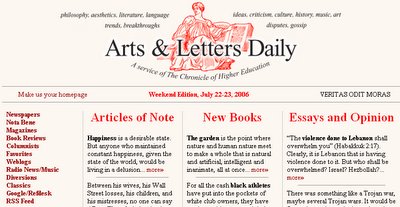
i do recommend this site to the intellectually hungry. the writers are good, so unlike the assigned readings in my class. below are some of the articles i've noted. i haven't read them yet but i'm blogging about it to remind myself to read them.
Some Dark Thoughts on Happiness
>> Learn about the Authentic Happiness Inventory (i think it's supposed to be a tool that objectively measures authentic happiness. or something), and the people who study happiness for a living
'The Most Optimistic Country in the World'
>> Discover the growing purchasing power of the middle class of india. "Socially and economically, India is developing at a galloping pace when compared to the rest of the world." my professor warned the class about this. make way for the new india.
An excerpt from The Economics of Attention
>> I've read somewhere that while information technology is the thing of this century, the next will be creativity. Richard Lanham tells us more in this article as he claims that artists are the ultimate “economists of attention,” the real experts in grabbing their chunk of our mind-share.
The Freedom to Ridicule Religion -- and Deny the Holocaust
>> Although I don't absolutely agree, I have deep respect for Peter Singer's writings on philosophy, particularly on the subject of animal rights. Here, he maintains that "...we must preserve our freedom to deny the existence of God and to criticize the teachings of Jesus, Moses, Muhammad, and Buddha..." and that "freedom of expression must include the freedom to ridicule as well." surely, a good read...
Goodbye, Blog
>> Alan Jacobs explores the architecture of blogs and the impossibility of real conversation in the blogosphere. he's right: life is too busy to keep the momentum of debating. ironically (or perhaps intentionally), there is no "comments" link at the end of his article.
but i did have a witty answer in mind. i would've been proud to let my classmates know that much of my "intellectual" reading is sourced from the arts and letters daily's collection of articles from the net.
i do recommend this site to the intellectually hungry. the writers are good, so unlike the assigned readings in my class. below are some of the articles i've noted. i haven't read them yet but i'm blogging about it to remind myself to read them.
Some Dark Thoughts on Happiness
>> Learn about the Authentic Happiness Inventory (i think it's supposed to be a tool that objectively measures authentic happiness. or something), and the people who study happiness for a living
'The Most Optimistic Country in the World'
>> Discover the growing purchasing power of the middle class of india. "Socially and economically, India is developing at a galloping pace when compared to the rest of the world." my professor warned the class about this. make way for the new india.
An excerpt from The Economics of Attention
>> I've read somewhere that while information technology is the thing of this century, the next will be creativity. Richard Lanham tells us more in this article as he claims that artists are the ultimate “economists of attention,” the real experts in grabbing their chunk of our mind-share.
The Freedom to Ridicule Religion -- and Deny the Holocaust
>> Although I don't absolutely agree, I have deep respect for Peter Singer's writings on philosophy, particularly on the subject of animal rights. Here, he maintains that "...we must preserve our freedom to deny the existence of God and to criticize the teachings of Jesus, Moses, Muhammad, and Buddha..." and that "freedom of expression must include the freedom to ridicule as well." surely, a good read...
Goodbye, Blog
>> Alan Jacobs explores the architecture of blogs and the impossibility of real conversation in the blogosphere. he's right: life is too busy to keep the momentum of debating. ironically (or perhaps intentionally), there is no "comments" link at the end of his article.
Apr 7, 2006
The Lost Gospel
this i gotta see...

judas iscariot just might turn out to be a martyr, a hero -- an almost ridiculous abnegation to the long believed "fact" that judas betrayed jesus for a few silver coins. a definite must-see for all orthodox preachers, blind faithfuls, even agnostics and atheists.
---------------------------
Watch it onMonday, April 10, 10PM (Manila) on NGC. Or click the photo to visit the NGC website dedicated on this global television event.
judas iscariot just might turn out to be a martyr, a hero -- an almost ridiculous abnegation to the long believed "fact" that judas betrayed jesus for a few silver coins. a definite must-see for all orthodox preachers, blind faithfuls, even agnostics and atheists.
The Gospel of Judas gives a different view of the relationship between Jesus and Judas, offering new insights into the disciple who betrayed Jesus. Unlike the accounts in the canonical Gospels of Matthew, Mark, Luke, and John, in which Judas is portrayed as a reviled traitor, this newly discovered Gospel portrays Judas as acting at Jesus' request when he hands Jesus over to the authorities.
The Gospel of Judas is an exclusive, two-hour global television event that traces the incredible story of one of the most important finds in biblical archaeology.
Visit National Geographic's official Gospel of Judas site for detailed accounts of the discovery of the papyrus codex, information on the conservation of the document, and an illustrated, interactive history of early christianity.
---------------------------
Watch it on
Subscribe to:
Posts (Atom)